

From a scrapbook of press cuttings and photographs, compiled by I.R.A. Intelligence, 1919-1921,
1889 Jul 19. Born Mayo

1909 Jul 1 Enlisted in RIC. He was a Farmer
1910 Jan 1 Posted to Galway
1915 Sep 8 Unfavourable report
1916 Nov 30 Favourable report
1919 Aug 4, Eugene resigned in protest when he was transferred due to his very active role in the Police Union, but was re-instated, with all Service Restored, from Dec 5, 1919.
1919 Dec 5 readmitted to RIC
1920 Mar 24 Posted to Limerick
1920 Jul 12 Favourable Report
1920 Aug 1 Posted to Reserve
1920 Dec 4 A Volunteer , Michael Howley was shot at Broadstone Station in Dublin. The armed men who shot Joe Howley in Dublin were thought by the IRA to be part of a unit of R.I.C. dressed in civilian clothes set up by the British authorities tasked with identifying and shooting Irish volunteers travelling to Dublin from the West of Ireland.
Howley was summoned to Dublin by the IRA leadership less than a fortnight after ‘Bloody Sunday’, tensions were high in Dublin , with Crown forces actively looking for republicans. Apparently, Howley was approached by a relative named Leahy at the station, who shook his hand and was warned him of trouble ahead (Joe Togher, BMH.WS1729). As he left the station, Howley was challenged by two men and he was shot and mortally wounded. The assassins were immediately picked up by car and disappeared.
A military court of inquiry took place behind closed doors. One of the assassins stated: “On December 4, 1920, at about 6.25pm, I was on patrol duty watching for ‘wanted’ men. He [Howley] was one of the ‘wanted’ men whom I knew was on the run in Galway. I knew Howley by repute as being a leading member of the I.R.A. and a desperate character. There were a great many people coming out of the railway station who had arrived by the 6.20pm train from Galway. I followed Howley, who was accompanied by another man [Mullins], intending to arrest him, as it was my duty to do so as soon as he got away from the crowd. There was another man with me. When Howley was about seventy yards outside the inner gate going towards Capel-street, I and the other man with me caught up with Howley. I placed my left hand on his shoulder, and told him to put up his hands. Howley wrenched himself free and put his hand in his pocket at the same time, diving to the left away from me. […] Believing that Howley was going to fire, I fired at him twice. The man with me also fired. Howley fell” (Connacht Tribune, 1 January 1921). A second witness, who was also on duty, corroborated his evidence. In consequence, the military court found that the shooting was justified, as Howley had – allegedly – attempted to evade arrest.
Later, Mullins gave a very different account of that incident: “We arrived at Broadstone shortly after dusk. As we were crossing the bridge outside the Broadstone [Station] I thought I felt the presence of persons behind us. I half glanced over my shoulder and I saw the figures of four or five men behind in a half circle, and saw one figure at Howley’s right shoulder jam a gun […] into Howley’s head. Simultaneously I heard shots”. Mullins ran for cover and when he looked back he saw Howley “lying on the ground, a girl or woman kneeling beside him raising his head and putting a [rosary] beads into his hands”. By this account, there was no attempt made to arrest Howley.
It was believed locally that RIC Sergeant James Healy, a Sligo man stationed at Oranmore, had followed Howley to Dublin and identified him to his killers. Soon after Howley’s death, Healy was promoted to district inspector and transferred to Dunmore, Co. Galway, where the local IRA made several attempts to assassinate him because of his alleged connection to Howley’s death (Thomas Mannion, BMH.WS1408).

Dalton wrote of Igoe
The personnel of Igoe's party was never fully established, beyond the fact that it contained members from the different " hot spots" in the country. They were all Irishmen who had considerable service in the R.I.C.,with the exception of a Scotsman who was known as Jock. He may have become associated through his membership of the Black and Tans. Due to the fact that he had committed some crime, they did not want him to appear in police uniform.
1921 Jan 1 Promoted Sgt
1921 Feb 12 Promoted Temp Head Constable
1921 Jul 11 Promoted permanent Head Constable
1921 Jul 7 IRA Inteligence report that Igoe is in Galway
1921 Oct 2 Posted to London for his own safety (Sturgis)
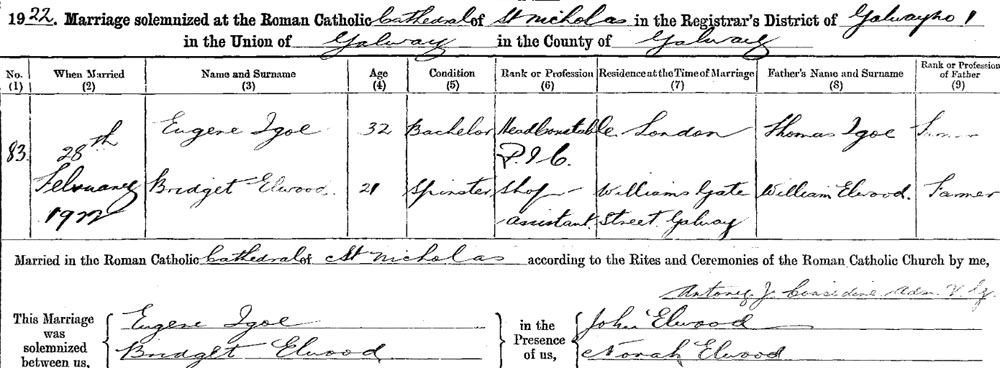
1922 Feb 28. Igoe married in Galway, was "exiled" to London in 1922, and returned later to live in Northern Ireland.
1922 Apr 5 Dsibanded from RIC
1922 Dec 26 Igoe approached the RIC Tribunal with a further request to increase his disturbance allowance and also a back claim for expenses. The total was £2397 on top of his existing pension
Sir Ormonde Winter (who was then in charge of the Re-Settlement Branch ) told the Tribunal that Igoe could not safely remain in any part of the United Kingdom, and, in fact, that wherever he might go it would be necessary for him to sink his identity, as if his identity became known in any part of the world he would at once be in danger of losing his life". In they recommended (and it was effected) that "he should be given a lump sum of £500 in lieu of the normal disturbance allowance to enable him to move on short notice from one part of the world to another, and that in addition a Government Annuity of £60 per annum should be bought for him to augment his compensation allowance and supply him with reasonable means of subsistence even though he may be unable to take up settled work in any part of the world." (Treasury Minute)
1926 Nov 7. Igoe wrote to the RIC Pensions Commutation Branch in Whitehall (signing himself F W Willson) saying he wanted to buy a farm and pub on the London to Brighton Road in Sussex.. The requested that he commute his pension. He referenced help he had provided to the Treasury in April 1925, in the Case of the National Shell Factory (Irish Free State) vs. Treasury (Compensation Claims). This was an attack on the National Shell Factory, Parkgate St, Dublin, which was destroyed on the 3 June 1921. His claim was turned down on the basis his allowances had been awarded because he could not live in one place and running a pub and grocery store would make him permanent
Eugene Igoe was employed as head of security at the US Airforce/RAF bases in Enniskillen during WW2. This was at the flying boat station at RAF Killadeas.
After he retired from the security job, he lived in Lisburn.
He had two children, Noel and Florence. Noel A. Igoe was born around 1926 and studied at Trinity College Dublin around 1957. A Gold Medallist, he was to become President of the Union of Students in Ireland from 1960-62.
1935 The family were living at The Corners, Lower Ballinderry when Eugene's young son Noel inadvertently revealed their address. The 'Irish Weekly' newspaper had a Children's Corner and announced that they were forming a club for their young readers. Among those was Noel (and Bridget) Igoe. The Bridget is his sister was Mary Florence. What he or his parents had not anticipated was that the newspaper would later publish the names and addresses of the club members. Their address was given as The Corners, Lower Ballinderry.
1969 Oct 16. Died in Lisburn
British Intelligence Dublin Castle
1975 letter by RIC Sgt John Peter Clarke to a newspaper confirmed he was in Igoe's squad Clarke seems to have been one of 10 children of an RIC man, James Clarke, born County Cavan around 1859 . Sgt JP Clarke was born in County Mayo and by 1901 his father was stationed in Ballaghaderreen, NW County Roscommon, and by 1911 was an RIC Pensioner.
An IRA Intelligence report for Dunleary (sic) . I assume probably the son of Sir Valentine Grace of Boley.
